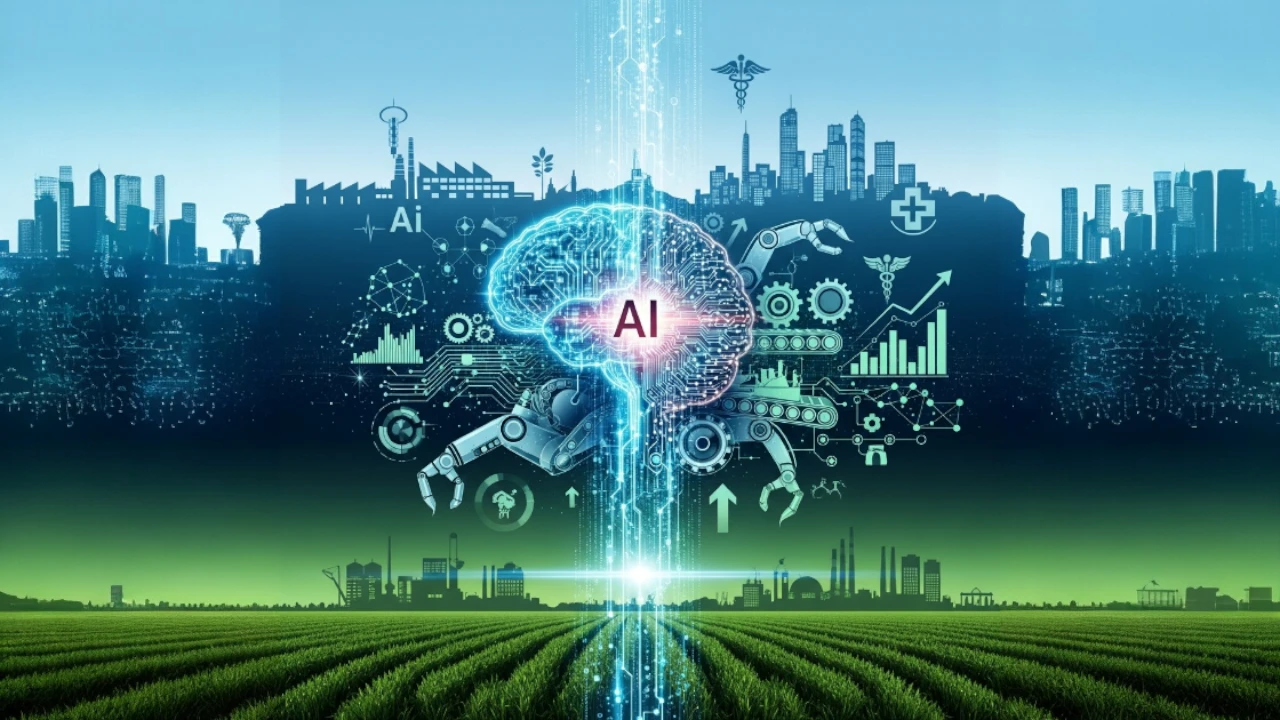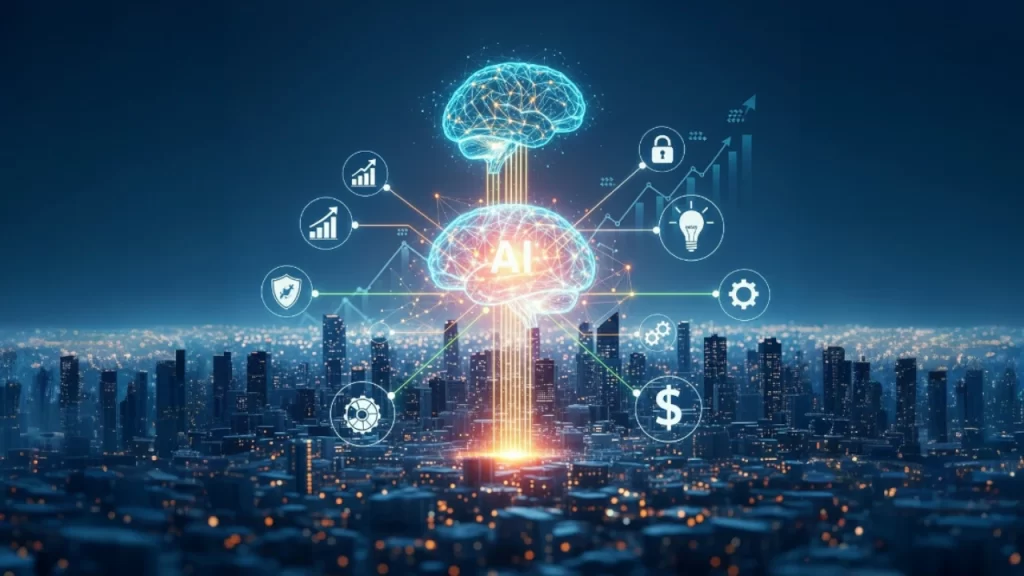
Artificial Intelligence (AI) is no longer futuristic—it’s now one of the most powerful tools businesses rely on for growth. From managing massive data streams to enhancing productivity and delivering personalized customer experiences, AI is actively solving the biggest challenges companies face today.
What sets AI apart is its ability to learn, predict, automate, and optimize—faster and more accurately than ever before. Whether you’re running a startup or a large enterprise, understanding how AI drives transformation is essential to staying competitive.
In this deep-dive, we explore how AI is reshaping business ecosystems, the challenges it solves, real-world use cases, and how organizations can integrate smart AI solutions responsibly and safely.
Table of Contents
ToggleThe Rising Need for AI in Modern Business
Global industries are changing rapidly. Consumer expectations are increasing, markets are evolving, and data is exploding in quantity and complexity. Business leaders must accelerate decision-making, boost efficiency, prevent loss, and innovate with speed.
AI helps by:
- Automating repetitive tasks
- Delivering deeper insights from big data
- Enhancing customer experience
- Increasing operational efficiency
- Reducing errors and risks
- Driving innovation
Because of this, AI adoption is growing at record speed. Companies that effectively use AI are outperforming competitors, scaling faster, and maintaining customer loyalty with personalized experiences.
How AI Solves the Biggest Business Challenges
Challenge: Managing Overwhelming Data
Solution: AI-Powered Analytics & Insights
Businesses generate more data than ever—from customer interactions to operations, logistics, social media, and beyond. But raw data means nothing without interpretation.
AI assists by:
- Extracting insights from structured and unstructured data
- Identifying trends and patterns
- Improving forecasting accuracy
Smart algorithms turn complex data into actionable insights, helping teams make faster, more informed decisions.
Real-world Example:
Retail giants use AI to forecast customer demands, optimize inventory, and improve supply chain performance.
Challenge: Repetitive & Time-Consuming Tasks
Solution: Intelligent Automation
AI-driven automation frees employees from low-value repetitive tasks so they can focus on meaningful work.
Tasks AI automates:
- Data entry
- Administrative processes
- Customer support FAQs
- Billing & processing
- Email sorting
This not only saves time and reduces costs—it boosts employee creativity and productivity.
LSI keywords: workflow automation, AI tools, productivity automation
Challenge: Poor Customer Experience
Solution: AI-Enhanced Engagement & Support
Customer expectations are higher than ever. People want fast, accurate responses and personalized service.
AI helps by:
- Powering chatbots for 24/7 support
- Tailoring product recommendations
- Personalizing marketing messages
- Using sentiment analysis to improve relationships
The result:
Better satisfaction, deeper loyalty, and higher conversions.
Challenge: Inefficient Hiring & Talent Shortage
Solution: AI-Guided Recruitment & HR
HR teams struggle with candidate screening, time-to-hire, and matching skills to roles.
AI streamlines recruitment by:
- Pre-screening resumes
- Matching candidates to job profiles
- Predicting culture fit
- Reducing human bias
This speeds up hiring while improving quality.
Challenge: Rising Cybersecurity Threats
Solution: AI-Powered Threat Detection
Cyberattacks are increasing—and becoming more sophisticated.
AI improves defense by:
- Detecting threats in real time
- Predicting attack patterns
- Flagging abnormal behavior
- Automatically responding to threats
AI security models are faster and more accurate than traditional systems, protecting valuable data from breaches.
Challenge: Slow Decision-Making
Solution: AI Decision Intelligence
Businesses must make fast, accurate decisions to stay competitive.
AI supports decision-making by:
- Running predictive models
- Evaluating outcomes
- Suggesting optimal business strategies
From supply chain optimization to financial planning, AI guides leaders toward better choices.
Challenge: Scaling Operations Efficiently
Solution: AI-Driven Optimization
AI helps companies grow without expanding costs at the same rate.
AI optimizes:
- Manufacturing
- Logistics
- Inventory
- Workflows
- Resource allocation
It makes scaling smoother, more sustainable, and more data-driven.
Business Areas Impacted Most by AI
Customer Experience
- Chatbots
- Voice assistants
- Personalized journeys
Marketing
- Predictive content
- Targeting & segmentation
- Campaign automation
Finance
- Fraud detection
- Smart forecasting
- Automated accounting
Operations
- Supply chain optimization
- Warehouse automation
HR
- Screening
- Upskilling
- Performance management
Real-World AI Use Cases
Healthcare
Predictive analytics for diagnosis, personalized treatment, automated admin tasks.
Retail
Recommendation systems, predictive demand, automated checkout.
Manufacturing
Predictive maintenance, robotic automation.
Finance
Fraud detection, portfolio management, risk assessment.
Benefits of AI for Businesses
- Reduced operational costs
- Faster decisions
- Better customer satisfaction
- Increased efficiency
- Stronger cybersecurity
- Improved innovation
- Scalable growth
Potential Risks & How to Manage Them
| Risk | Solution |
|---|---|
| Privacy concerns | Strong data governance |
| AI bias | Diverse training datasets |
| High implementation cost | Scalable adoption |
| Job displacement | Upskilling programs |
| System dependency | Human oversight |
Smart planning and responsible deployment maximize benefits while minimizing risks.
How to Implement AI Successfully
Follow these steps to adopt AI smoothly:
Define Objectives
Know the problem before choosing a tool.
Audit Your Data
High-quality data = highly accurate AI results.
Start Small
Test with pilot programs.
Upskill Employees
Train teams to collaborate with AI.
Evaluate ROI
Track performance and results.
Scale
Grow AI adoption across the company.
Internal Link Suggestions
(Examples—replace with your site links)
- Workflow automation strategies
- Best tools for workplace efficiency
- How to improve customer experience
External Authoritative Sources
- IBM
- McKinsey
- Gartner
FAQs
What is AI in business?
AI in business refers to technology that learns from data to improve operations, decision-making, and customer experience.
Is AI expensive to implement?
Costs vary, but small businesses can start with affordable AI tools and scale over time.
Will AI replace jobs?
AI reduces repetitive tasks, but it also creates new roles and opportunities; upskilling is key.
How does AI improve customer service?
AI delivers instant support, personalized recommendations, and faster solutions.
What industries benefit most from AI?
Finance, retail, healthcare, logistics, and manufacturing see massive AI value.
Conclusion
AI is no longer optional—it’s a core driver of business success. From improving efficiency and cutting costs to personalizing customer experiences and supporting smarter decisions, AI helps companies overcome major challenges and unlock new opportunities.
Whether you’re a startup or an enterprise, investing in AI now will give you a significant edge as the business world becomes more intelligent, automated, and data-driven.
The future belongs to businesses that innovate—AI is the key unlocking that future.