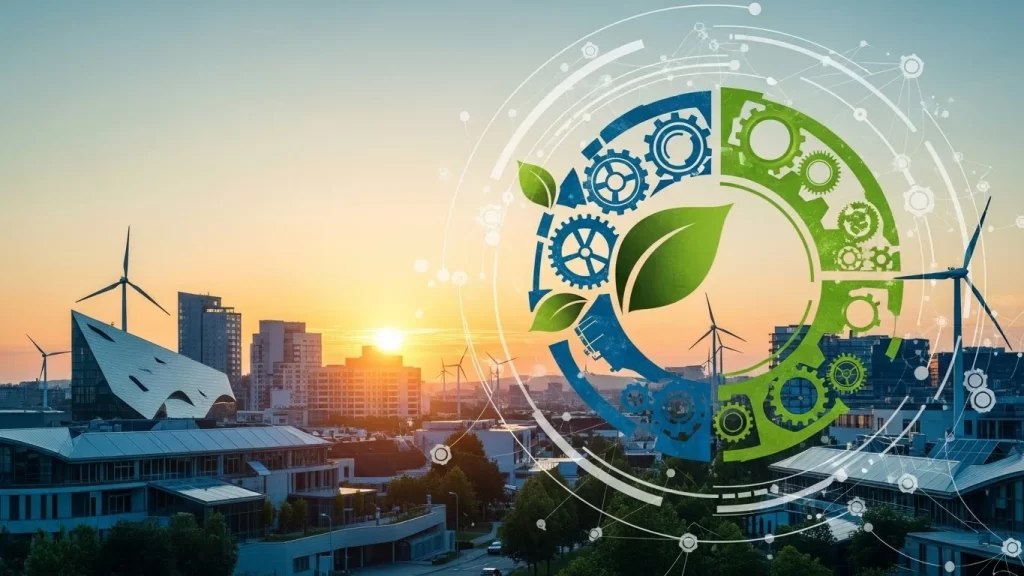
A silent revolution is reprogramming the global economy’s DNA. What began as a niche concern for environmental activists has erupted into the most powerful driver of industrial transformation since the digital revolution. Sustainability and green innovation are no longer mere compliance exercises or marketing slogans; they are fundamental forces dismantling legacy systems, creating trillion-dollar markets, and redefining what it means to be competitive. For innovators, this represents an unprecedented moment of opportunity and urgency. This comprehensive exploration moves beyond the “why” to reveal the “how”—delivering key insights into the mechanisms through which green innovation is actively reshaping major industries and providing a strategic blueprint for those ready to build the future, not just adapt to it.
Table of Contents
ToggleThe Unstoppable Momentum: Why This Is More Than a Trend
The transformation is propelled by a powerful convergence of forces. Stringent global climate accords, like the Paris Agreement, are translating into hard regulatory deadlines. Conscious consumers, empowered by information, are voting with their wallets for transparency and responsibility. Perhaps most decisively, institutional investors and financial markets are now pricing Environmental, Social, and Governance (ESG) factors directly into valuations, making sustainable practices a core component of risk management and capital allocation. This triad of pressure—regulatory, consumer, and financial—has moved sustainability from the periphery to the center of corporate strategy, making green innovation the primary engine for growth, resilience, and relevance in the 21st century.
Industry Transformation in Action: Where the Reshaping Is Happening
The Energy Sector: Beyond Fossil Fuels to System-Wide Reimagining
The energy industry’s shift is the most visible, moving from centralized, extraction-based models to distributed, intelligent, and renewable systems.
- Key Innovation: The integration of AI-powered smart grids with utility-scale battery storage and decentralized renewable sources (solar, wind). This creates resilient, self-optimizing energy networks.
- Insight for Innovators: The opportunity lies not just in producing green energy, but in managing, storing, and trading it. Innovations in grid-edge technologies, demand-response platforms, and long-duration energy storage are critical.
Manufacturing & The Circular Economy: From “Take-Make-Waste” to Regeneration
Linear production is being obsolete by circular models that design out waste. Industries are rethinking everything from materials to product end-of-life.
- Key Innovation: Advanced material science is producing biodegradable polymers, self-healing composites, and metals derived from recycling streams. Companies like Patagonia (with Worn Wear) and Philips (with “light-as-a-service”) are pioneering product-life extension models.
- Insight for Innovators: Focus on design for disassembly and material traceability. Innovate in reverse logistics and chemical recycling processes to close loops for complex products like electronics and textiles.
Transportation & Mobility: The Electrification and Connectivity Pivot
The race extends beyond electric vehicles (EVs) to a holistic redefinition of mobility.
- Key Innovation: The convergence of electric propulsion, autonomous driving software, and Mobility-as-a-Service (MaaS) platforms. This points toward a future of shared, autonomous, electric fleets.
- Insight for Innovators: Address the ecosystem gaps: charging infrastructure scalability, second-life applications for EV batteries, and software for seamless multi-modal urban transport integration.
Agriculture & Food Tech: The Rise of Precision and Alt-Protein
One of the planet’s most resource-intensive industries is getting a data-driven, biological overhaul.
- Key Innovation: Vertical farming and cellular agriculture. Using controlled-environment agriculture and bioreactors to produce food with >95% less water and land, decoupling production from environmental degradation.
- Insight for Innovators: Leverage AI and IoT for hyper-local, precision-fertilizer and water use. Develop scalable bioprocesses for cultivated meat and fermentation-derived proteins to diversify the food supply sustainably.
Key Insights for Innovators: Navigating the Green Transition
To successfully innovate in this space, certain principles are non-negotiable.
Insight 1: Systems Thinking is Your Primary Tool
Green innovation rarely succeeds in a vacuum. You must map the entire system your solution operates within.
- Actionable Step: Conduct a lifecycle assessment (LCA) for your product or service from day one. Understand its full environmental footprint—from raw material sourcing to end-of-life. Identify the key leverage points for maximum positive impact.
Insight 2: Collaborate Across Unusual Boundaries
The complexity of sustainability challenges demands hybrid expertise.
- Actionable Step: Forge partnerships outside your traditional sphere. A tech innovator might partner with waste management firms. A fashion brand might collaborate with chemical engineers developing enzymatic textile recycling. Consortia and pre-competitive collaborations are increasingly vital.
Insight 3: Embrace the Power of Digital Twins and AI
Digitalization is the force multiplier for green innovation.
- Actionable Step: Use AI and machine learning to optimize complex systems for efficiency: energy use in buildings, predictive maintenance to extend machinery life, or routing logistics to minimize fuel consumption. Develop digital twins of physical systems (a factory, a supply chain) to simulate and test sustainability improvements without real-world cost or risk.
Insight 4: Measure and Communicate Impact with Rigor
Trust is built on transparent, verifiable data. Greenwashing carries severe reputational and financial risk.
- Actionable Step: Integrate impact measurement into your core metrics. Align with standardized frameworks like the Global Reporting Initiative (GRI) or the Task Force on Climate-related Financial Disclosures (TCFD). Use blockchain for immutable supply chain provenance tracking.
The Core Strategies Driving Sustainable Innovation
| Strategy | Definition | Example |
|---|---|---|
| Circular Design | Designing products for longevity, reuse, repair, and recyclability from the outset. | Fairphone: Modular smartphones designed for easy repair and upgrade. |
| Clean Technology | Developing products/services that directly reduce negative environmental impact. | CarbonCure: Injecting captured CO2 into concrete, permanently sequestering it and strengthening the material. |
| Biomimicry | Innovating by emulating nature’s time-tested patterns and strategies. | Pax Scientific: Applying hydrodynamic principles from nature to create ultra-efficient fans, mixers, and turbines. |
| Product-as-a-Service (PaaS) | Shifting from selling products to selling the service they provide, aligning profit with resource efficiency. | Interface: Selling “floor-covering services” instead of carpet tiles, retaining ownership and responsibility for recycling. |
Common Pitfalls to Avoid in Green Innovation
- “Bolt-on” Sustainability: Trying to add green features to an inherently unsustainable core model. Innovation must be foundational.
- Ignoring the Just Transition: Failing to consider the social and employment impacts of your innovation, which can lead to backlash and policy hurdles.
- Over-reliance on Offsetting: Using carbon offsets as a primary strategy rather than a last resort after genuine operational reductions. The market increasingly scrutinizes this.
- Underestimating Policy & Regulation: Viewing regulations as a barrier rather than a signal of future market direction and a source of competitive advantage for early movers.
- Data Vagueness: Making broad claims (“greener,” “eco-friendly”) without specific, third-party-verified data to support them.
Frequently Asked Questions (FAQs)
1. Is green innovation only viable for large corporations with big R&D budgets?
No. In fact, agility often gives startups and SMEs an advantage. Many of the most disruptive green innovations come from startups leveraging new technologies (e.g., in alt-protein, material science). Scalability can be achieved through strategic partnerships and venture capital increasingly focused on climate tech.
2. How do I balance sustainable innovation with cost concerns?
Adopt a Total Cost of Ownership (TCO) and value-creation perspective. While initial costs may be higher, innovations that reduce energy use, waste disposal fees, and material consumption, or that unlock new revenue through circular models, often have a superior long-term financial profile. Also, explore green financing options (green bonds, sustainability-linked loans).
3. What is the single most important skill for an innovator in this space?
Systems thinking. The ability to understand interconnectedness—how a change in material affects supply chain logistics, manufacturing energy use, product lifetime, and end-of-life recycling—is paramount. This transcends traditional disciplinary silos.
4. How can I protect my green innovation intellectually property?
The IP landscape is evolving. Beyond traditional patents, consider open-source models for foundational technologies to accelerate ecosystem growth, while patenting specific, proprietary applications. Also, investigate green patent fast-tracking programs offered by many patent offices globally.
5. How do I measure the success of a green innovation project?
Move beyond pure financial KPIs. Develop a balanced scorecard including:
- Environmental: Carbon reduction, waste diverted, water saved (measured via LCA).
- Business: Cost savings from efficiency, new market revenue, customer retention.
- Strategic: Influence on industry standards, brand equity enhancement, talent attraction.
6. Is consumer demand really strong enough to drive this change?
While growing, relying solely on voluntary consumer choice is insufficient. The most powerful model is “good for the planet, better for the customer.” The innovation must offer a superior performance, cost, or experience benefit (e.g., EVs’ lower maintenance and instant torque) alongside the sustainability benefit. This creates a non-compromise adoption driver.
Conclusion: The Innovator’s Mandate in the Age of Sustainability
The reshaping of industries by sustainability and green innovation is not a distant forecast; it is the operating reality of our time. This transformation presents a clear mandate for innovators: to become architects of a regenerative economy. The insights are clear—think in systems, collaborate radically, leverage digital intelligence, and measure what truly matters. The path forward is one of intentional design, where value creation is decoupled from environmental degradation and coupled instead with restoration.
For the innovator, this is the ultimate design challenge and the greatest market opportunity in a century. It requires courage to reimagine fundamentals and the pragmatism to build scalable solutions. The industries that will dominate the coming decades are being built today by those who see not constraints, but possibilities; not costs, but investments in a viable future. The question is no longer if all innovation will become green innovation, but how quickly you will position yourself at its forefront. Start mapping your ecosystem, find your leverage point, and begin building. The future is not just coming—it’s waiting to be engineered.