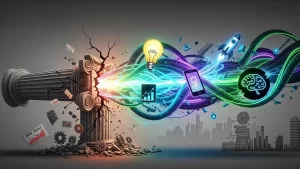
We are witnessing a quiet revolution in the global economy—one driven not by corporate giants with vast resources, but by agile minds with unconventional ideas. Creative entrepreneurship has emerged as the most potent force for industry transformation in the 21st century. It represents a fundamental departure from traditional business models, where innovation is often incremental and risk-averse. Instead, creative entrepreneurs view the world through a lens of possibility, identifying gaps, inefficiencies, and unmet desires that established players overlook. This is not merely about starting a business; it’s about rewriting the rules of an entire sector. From sustainable fashion and direct-to-consumer health tech to the creator economy and experiential retail, these innovators are proving that imagination, paired with execution, can reshape industries from the ground up. This guide delves into the core mechanisms of this shift and delivers essential insights for any innovator ready to leave a mark.
Table of Contents
ToggleThe Mindset Shift: From Linear Thinking to Creative Problem-Solving
The foundation of creative entrepreneurship lies in a distinct cognitive approach. It moves beyond linear, profit-first business planning to embrace divergent thinking—the ability to generate many unique solutions to a single problem.
- The Insight: Traditional business asks, “How can we do this better or cheaper?” Creative entrepreneurship asks, “Why does this exist in this form at all? What if we approached it from a completely different angle?” It’s the difference between building a faster horse and envisioning the automobile.
- The Application: This mindset sees constraints (like limited funding or market saturation) not as barriers, but as catalysts for innovation. It blends artistic vision with analytical rigor, treating empathy, storytelling, and user experience as critical business metrics.
The Core Engines of Creative Industry Reshaping
Engine 1: Niche-First Innovation Over Mass Market Appeal
Instead of targeting broad demographics, creative entrepreneurs identify passionate, underserved niches and build deeply resonant brands for them.
- How It Reshapes Industries: By hyper-serving a niche, they often create entirely new sub-categories that eventually expand into the mainstream. Example: The athletic apparel industry was dominated by performance-first giants. Brands like Tracksmith reshaped it by focusing solely on the niche of “serious recreational runners,” offering heritage-inspired design and community storytelling, thereby carving out a high-margin segment that bigger players later scrambled to emulate.
Engine 2: Leveraging Technology as a Creative Canvas
Creative entrepreneurs use technology not just for efficiency, but as the core medium for their value proposition.
- How It Reshapes Industries: They turn software, platforms, and digital tools into vehicles for connection, personalization, and art. Example: The music industry was traditionally gatekept by labels. Platforms like SoundCloud and later Stem disrupted it by giving independent artists the creative canvas and distribution control to build careers on their own terms, fundamentally altering power dynamics.
Engine 3: Building Ecosystems, Not Just Products
The most impactful creative ventures move beyond selling a single item to curating an integrated system of products, services, and community.
- How It Reshapes Industries: This shifts competition from price and features to lifestyle and belonging. Example: Glossier didn’t just sell makeup; it built an ecosystem rooted in community-driven product development, content (Into The Gloss), and a distinct aesthetic. It reshaped beauty by making the brand feel like a friend and collaborator, forcing legacy brands to adopt more conversational, community-focused marketing.
Engine 4: Prioritizing Values as a Value Proposition
Profit and purpose are no longer seen as opposing forces. Creative entrepreneurs embed their core values—sustainability, equity, transparency—into the very fabric of their business model.
- How It Reshapes Industries: This forces entire sectors to become more accountable. Example: In the food industry, Patagonia Provisions applies its parent company’s environmental activism to food sourcing, promoting regenerative agriculture. This pressures larger CPG companies to examine and advertise their own supply chain ethics more closely.
Key Insights for the Modern Innovator
Insight 1: Your Uniqueness is Your Competitive Moat
Your personal experiences, quirks, and specific worldview are your greatest assets. In a world of homogenized corporate offerings, authentic uniqueness is defensible and compelling.
- Actionable Step: Conduct an “authenticity audit.” What do you care about that others in your industry ignore? What personal story can only you tell? Build your brand narrative around that irreducible core.
Insight 2: Launch to Learn, Not to Perfect
Creative entrepreneurship thrives on rapid iteration. The goal of a launch is not a flawless product, but to gather real-world feedback from real customers as quickly as possible.
- Actionable Step: Develop a Minimum Lovable Product (MLP)—a version with just enough features to be embraced by early adopters. Use their feedback as your primary R&D guide.
Insight 3: Master the Art of Resourcefulness (The “Scrappy” Advantage)
Limitations breed creativity. Having fewer resources often leads to more innovative partnerships, marketing tactics, and product designs.
- Actionable Step: Practice constraint-based brainstorming. Challenge yourself: “How could we solve this customer problem if we had only $500 and 30 days?” The solutions are often more creative and asset-light.
Insight 4: Cultivate Cross-Disciplinary Curiosity
Breakthrough ideas almost always happen at the intersection of fields. A tech solution applied to a farming problem, or a hospitality mindset applied to healthcare, can reshape an industry.
- Actionable Step: Dedicate time each week to learning about a field entirely unrelated to your own. Attend a talk, read a journal, or listen to a podcast outside your bubble. Ask, “What patterns or solutions here could apply to my industry?”
A Framework for Creative Disruption
| Phase | Objective | Key Activities for the Innovator |
|---|---|---|
| 1. Observation & Sense-Making | Identify a deep, often unarticulated tension or desire. | Immersive user research, trend cross-referencing, “jobs to be done” analysis. Look for where people are hacking existing solutions. |
| 2. Conceptual Reframing | Redefine the problem and envision a radical new approach. | “What if?” brainstorming, analogical thinking (e.g., “What would Airbnb do for this?”), business model canvas exploration. |
| 3. Prototyping & Storytelling | Make the idea tangible and build narrative around it. | Build an MLP, create a compelling pitch deck/film, share the vision with a small community to gather evangelists. |
| 4. Agile Launch & Ecosystem Building | Enter the market and cultivate a community of users and collaborators. | Soft launch, leverage user-generated content, forge strategic partnerships, layer in community features. |
| 5. Scale & Systematize | Grow the impact while protecting the core creative vision. | Document the “why,” empower a team that shares the values, scale the ecosystem, not just the product. |
Common Pitfalls for the Creative Entrepreneur
- Falling in Love with the Solution, Not the Problem: Passion for your idea can blind you to market fit. Stay obsessed with the customer’s problem.
- Neglecting the “Business” in Creative Business: Vision without financial acumen, operational structure, and scalability leads to a beautiful, failed experiment.
- Isolating in a Creative Bubble: Creativity needs feedback. Building in isolation, without engaging customers or pragmatic advisors, is a recipe for irrelevance.
- Scaling Too Fast, Too Soon: Scaling prematurely can dilute what made the venture special, overextend resources, and break the culture.
- Failing to Protect Creative Energy: Burnout is the enemy of innovation. The non-linear, emotional work of creation requires guarded time for rest and inspiration.
Frequently Asked Questions (FAQs)
1. I’m not an “artist.” Can I still be a creative entrepreneur?
Absolutely. Creativity here is not about artistic talent; it’s about problem-solving creativity. It’s the ability to connect disparate ideas, envision new systems, and communicate compellingly. Engineers, scientists, and accountants can be profoundly creative entrepreneurs.
2. How do I protect a creative business idea without patents?
In many cases, speed and execution are better protection than patents. Focus on building brand authority, community loyalty, and operational excellence. Your unique combination of vision, customer relationships, and agile iteration is harder to copy than a single product feature.
3. Is venture capital (VC) funding at odds with creative entrepreneurship?
Not necessarily, but it can be. VC often seeks rapid, scaled returns. If your venture’s success is tied to niche authenticity, slow community growth, or non-traditional metrics, alternative funding (bootstrapping, revenue-based financing, crowdfunding, grants) may better preserve your creative control and vision.
4. How do I measure the success of a creative venture?
Beyond standard KPIs (revenue, CAC, LTV), track vision-aligned metrics: community engagement depth, customer story quality, press sentiment, impact metrics (e.g., waste diverted, artists supported), and team culture health. Define what “impact” means for you.
5. What’s the role of failure in creative entrepreneurship?
It is an essential data point. Creative work involves high uncertainty. “Failures” are rarely total; they provide the critical feedback that guides your next, more informed iteration. The goal is to fail fast, learn cheaply, and persist.
6. How do I find a team that shares a creative vision?
Look for T-shaped individuals: people with deep expertise in one area (the vertical bar of the T) but broad curiosity and collaborative skills (the horizontal bar). Hire for cultural add, not just cultural fit—seek those who challenge and expand your perspective.
Conclusion: Your Canvas Awaits
The era of creative entrepreneurship signals that the most powerful tool for reshaping industries is a mindset—one that couples courageous imagination with relentless execution. It proves that you do not need permission to innovate; you simply need to observe keenly, reframe problems boldly, and act with intention. The landscapes of retail, media, food, finance, and healthcare are being permanently altered not by committees, but by individuals and small teams who dared to think differently.
As an innovator, your path is not to follow a map drawn by others, but to create a new one. Start by interrogating the industries around you. Where do you see friction, boredom, or unfulfilled potential? That is your canvas. Apply your unique perspective, leverage technology as your brush, and build not just for users, but for a community. The process will be non-linear, demanding equal parts resilience and flexibility. Yet, the reward is the ultimate creative act: building something meaningful that changes the market, and perhaps even the culture, forever. The invitation to reshape is open. Begin.