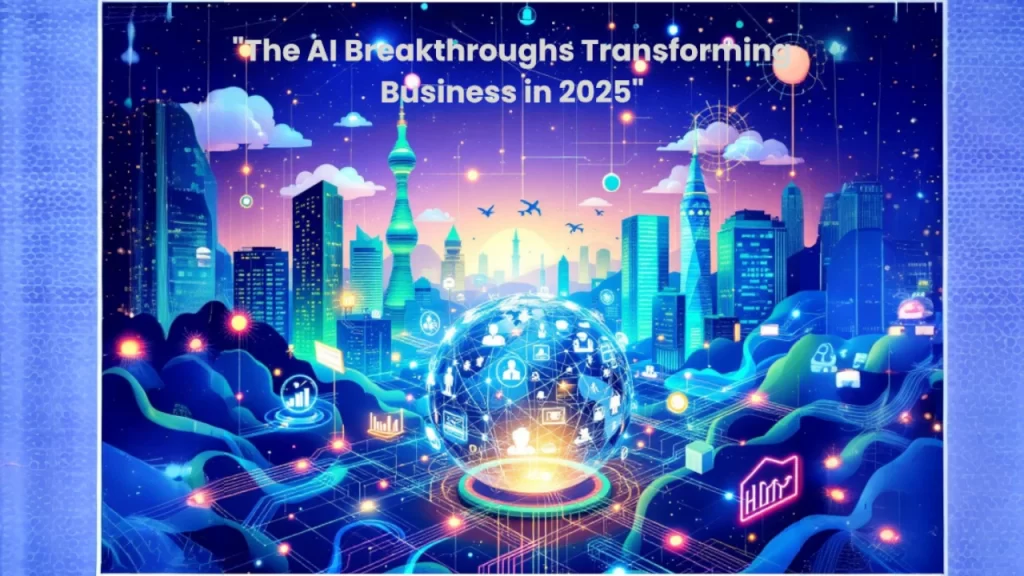
In 2025, businesses are no longer asking whether they should adopt artificial intelligence. Instead, they’re asking how fast they can implement it to stay competitive. From automating repetitive tasks to enabling predictive decision-making, AI has become the ultimate growth catalyst.
Companies that once viewed AI as a futuristic concept now rely on it for daily operations. This year marks a new era where AI isn’t just a tool—it’s a strategic partner. In this article, we’ll explore the biggest AI breakthroughs redefining business and how you can leverage them to gain a competitive edge.
Table of Contents
ToggleThe Rise of Intelligent Automation
Automation has existed for years, but in 2025, it has become intelligent. Unlike basic bots that only followed rules, modern AI-driven automation adapts and learns.
- Business process automation now handles complex workflows like payroll, customer support, and supply chain optimization.
- Hyperautomation combines AI, machine learning, and robotic process automation (RPA) to streamline entire departments.
- Businesses save both time and money, allowing teams to focus on higher-value tasks.
According to Gartner, companies that embrace hyperautomation in 2025 will see a 30% boost in efficiency compared to their competitors.
Personalized Customer Experiences Powered by AI
Customer expectations are higher than ever. AI-driven personalization ensures brands deliver exactly what consumers want—sometimes before they even ask.
- Recommendation engines provide hyper-relevant product suggestions.
- Chatbots and virtual assistants handle customer queries with near-human intelligence.
- Sentiment analysis helps businesses understand customer emotions in real time.
This level of personalization doesn’t just increase sales—it builds loyalty and trust. In 2025, businesses that ignore personalized experiences risk being left behind.
Predictive Analytics Driving Smarter Decisions
Data is the new oil, but without the right tools, it’s overwhelming. AI-powered predictive analytics transforms raw data into actionable insights.
- Retailers predict buying trends with accuracy.
- Healthcare providers anticipate patient needs before issues escalate.
- Financial firms forecast market shifts to reduce risk.
Instead of reacting to problems, businesses can anticipate challenges and seize opportunities faster than ever.
Natural Language Processing Reshaping Communication
Natural Language Processing (NLP) has taken a giant leap in 2025. Businesses now use NLP to enhance communication across languages, cultures, and industries.
- Real-time translation allows companies to operate globally without barriers.
- Advanced chatbots understand context, tone, and intent.
- Voice search optimization helps brands connect with mobile-first consumers.
With NLP, communication has become more seamless, breaking down global barriers and creating inclusive customer experiences.
AI-Driven Supply Chain Optimization
Supply chains faced global disruptions in recent years, but AI is solving these challenges in 2025.
- Demand forecasting ensures businesses produce the right amount of goods.
- AI-powered logistics optimize delivery routes, saving fuel and time.
- Risk management systems predict and prevent shortages.
These innovations not only reduce costs but also improve sustainability—something consumers and regulators are demanding more of.
The Role of AI in Cybersecurity
As digital threats evolve, so do defense systems. AI cybersecurity solutions in 2025 detect and neutralize attacks before they cause damage.
- Threat detection algorithms identify unusual patterns in real time.
- Adaptive security systems learn from every attempted breach.
- Fraud detection tools safeguard financial institutions and e-commerce businesses.
With cybercrime on the rise, AI has become a business’s most trusted defense mechanism.
Generative AI in Content and Product Innovation
Generative AI has moved beyond content creation. In 2025, businesses use it to design products, create prototypes, and even generate marketing campaigns.
- Retailers experiment with AI-generated fashion designs.
- Architecture firms create building models faster.
- Marketers test hundreds of ad variations in seconds.
The result? Faster innovation cycles and more creative output, giving companies an edge in highly competitive industries.
AI Ethics and Responsible Adoption
With great power comes great responsibility. In 2025, businesses can’t just adopt AI—they must use it responsibly.
- Transparent algorithms reduce bias.
- Ethical frameworks guide AI implementation.
- Businesses must comply with global AI regulations to avoid legal risks.
Companies that prioritize responsible AI build stronger reputations and long-term trust with customers.
Workforce Transformation with AI Collaboration
Instead of replacing jobs, AI in 2025 is transforming them. Businesses are investing in upskilling employees to work alongside AI tools.
- Workers use AI assistants to boost productivity.
- Sales teams leverage AI insights to close deals faster.
- Creative professionals collaborate with AI to generate fresh ideas.
The companies thriving in 2025 aren’t eliminating employees—they’re empowering them with AI tools.
The Competitive Advantage of Early Adoption
In 2025, the gap between AI adopters and laggards has widened. Early adopters enjoy:
- Higher efficiency
- Greater profitability
- Stronger customer loyalty
- Faster innovation cycles
Businesses that delay AI adoption risk falling behind in a marketplace that rewards speed, adaptability, and innovation.
FAQs About AI in Business
How is AI different in 2025 compared to previous years?
AI in 2025 is more advanced, adaptive, and integrated into every business process, making it essential rather than optional.
Which industries benefit most from AI breakthroughs?
Healthcare, finance, retail, logistics, and cybersecurity are seeing the biggest transformations.
Is AI too expensive for small businesses?
Not anymore—cloud-based solutions and scalable AI tools make adoption affordable even for startups.
What are the risks of using AI in business?
Potential risks include data privacy concerns, ethical issues, and reliance on poor-quality data.
How can businesses start adopting AI in 2025?
Begin with small, measurable projects like customer support chatbots or predictive analytics, then scale as results prove successful.
Conclusion: Shaping the Future with AI
The AI breakthroughs transforming business in 2025 are not just about efficiency—they’re about reshaping the way companies innovate, compete, and grow.
From personalized customer experiences to predictive analytics and cybersecurity, AI is the driving force of modern business strategy. The organizations that thrive this year will be the ones that view AI not as a luxury, but as a necessity for survival and success.
👉 Whether you’re running a startup or a global enterprise, the time to embrace AI is now. The future of business is data-driven, intelligent, and powered by AI breakthroughs.
For further insights, explore trusted resources like Harvard Business Review and World Economic Forum AI Reports.